Thursday, 14 April 2011

I Creep for a Woodpecker and a Tree Creeper Creeps for Me!


What lovely weather most of us in the UK have experienced in the last week or so. We had temperatures of well over 20C (68F) for several days and it was a pleasure to get out and enjoy all that Nature has to offer at this loveliest time of the year.


(Common Primrose)

'Now beauteous spring bursts forth to view,
And decks the earth with flow'rs,
And the songsters sing on dewy wing,
Rejoicing in the bow'rs.'
(Thomas Eagles)

As is so often the case in this country though the temperature has dipped again in the last day or so and is now less than half what it was!

Walking very near to home last weekend I kept hearing the laugh or yaffle of a Green Woodpecker. So often they are heard but not seen but on this occasion I had the last laugh :) as I saw it fly across in front of me and land in a tree in a hedgerow and was able to gradually creep closer to it with the camera.


Green Woodpecker


When I got home and processed the photos I was surprised to see that lower down in the tree, (as seen in the photo at the beginning of this post) there was also another woodpecker which I had been completely unaware of at the time.


'The green woodpecker flying up and down
With wings of mellow green and speckled crown.'
(John Clare)


During the same walk I was keeping an eye out in case I saw the Roe Deer which I had seen there (and posted about here) last year. This time I wasn't lucky enough to see them but I was thrilled instead to see this lovely little Muntjac Deer.


Muntjac Deer


The warm weather has brought all the Spring flowers out and I found this Green Alkarnet


Green Alkarnet


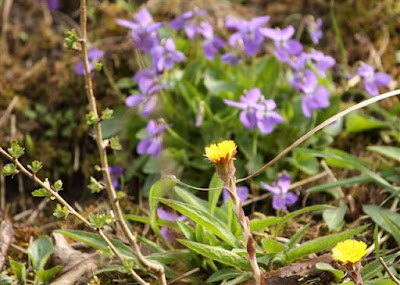
and these Coltsfoot with Violets in the background
.


Coltsfoot and Violets


These Marsh Marigolds, as their name suggests, were growing in their favoured habitat by water


Marsh Marigolds


and a flower which every year at this time, is just starting to spread its beautiful blue carpet over much of the woodland in the UK.


Bluebells

'The Bluebell is the sweetest flower
That waves in summer air:
Its blossoms have the mightiest power
To soothe my spirit's care.'
(Emily Bronte)


During a visit to Draycote Water it was lovely to see lots of delightful and vividly coloured Yellow Wagtails. I have seen them there each year I have been, either flitting around on the rocks or, as this time, on the grassy bank feeding on the many flies which so often plague the walkers, joggers and cyclists.


Yellow Wagtail


You can see the following one was actually sizing up its quarry!


The warm weather has of course also seen the welcome return of butterflies and after seeing many Orange Tips frustratingly whizz past me with no chance of a photo I was eventually rewarded with a nice open winged pose.


Orange Tip Butterfly (male)

'Child of the sun! pursue thy rapturous flight,
Mingling with her thou lov'st in fields of light;
And where the flowers of paradise unfold,
Quaff fragrant nectar from their cups of gold.'
(Charles Burton)


This Speckled Wood was the first I had seen this year and posed well for me.


Speckled Wood Butterfly


I should also have been able to post some nice photos of a Peacock butterfly but unfortunately I found that all of the ones I had taken of it as well as some of a Mallard with her tiny ducklings had mistakenly been taken with the white balance setting on my camera set to tungsten light instead of sunlight which meant all the photos had a horrible turquoise hue...I am still kicking myself!!

An unexpected find during the Draycote visit was a distant view of this Stoat which was no doubt preying on the numerous Rabbits which can always be seen there. It seems incredible that a creature so relatively small can catch and kill another much larger one. It pounces on the Rabbit, killing it with a bite to the back of its neck. If it is able to obtain more food than it can eat the Stoat will often store extra food for later. It is capable of speeds of 20mph when hunting and can cover a distance of around 4 miles in a single hunt! The collective name for Stoats is a 'caravan'.


Stoat


Another walk closer to home produced another unexpected sight. I think they are Red-legged Partridges but they could possibly be Chukar Partridges, again they were very distant.


Red-legged (or possibly Chukar) Partridges

'The partridge makes no nest but on the ground
Lays many eggs and I have often found
Sixteen or eighteen in a beaten seat
When tracing oer the fields or weeding wheat.'
(John Clare)


Finally, a couple of days ago, I was pleased to get some fairly decent photos of a Treecreeper at last. Usually I only manage one either disappearing round the back of a tree or completely out of focus.


Treecreeper


Have a good weekend and ... enjoy the beauty of Nature wherever you are.

Wednesday, 6 April 2011

Now That April's Here!


Thank you to everyone who left supportive comments on my last post concerning the Larsen Trap encounter and thank you most particularly to all those who signed the petition against them. If you haven't signed it yet please do consider it, every signature helps, wherever you live in the world!

Well what a beautiful April day it has been here today, we had a temperature this afternoon of 21c (69.8F). While visiting a small local lake it was a joy to see all the Spring flowers and hear Chiffchaffs calling their name over and over. I also heard a rustling in the dead leaves and caught a glimpse of a snake but it was so quick I couldn't identify it, my goodness they move fast! Looking back at my records I noticed that on this day in 2008 we had heavy overnight snow. Hopefully that won't happen tonight!

'When April comes with softly shining eyes,
And daffodils bound in her wind-blown hair,
Oh, she will coax all clouds from out the skies,
And every day will bring some sweet surprise,--
The swallows will come swinging through the air
When April comes!'
(Virna Sheard)


Clockwise from top left:
Ground Ivy, Cowslips, Bluebells,
Violets, Lesser Celandines and Primroses.


'Spring flowers, spring flowers,
Fairest, sweetest gems of earth,
Won from Eden's happy bowers,
Angels smiled upon your birth.'
(Louisa Shaw)


I hadn't seen Bramblings in the garden since 2008 when according to my records they visited from March 7th until April 22nd. At that time I didn't have a camera capable of taking bird photographs and have been disappointed not to have seen them since. However, since just before last Christmas I have seen one in the garden again and for the last few days a small flock have been visiting regularly and at last I have managed to get some photos. They really are lovely little birds.


Bramblings


Brambling (male)


Brambling (female)


I still haven't managed to photograph any butterflies but have seen, Brimstones and Small Tortoiseshells on some of the milder days we have had recently. It has been nice to see bees again too
.


Tawny Mining Bee?

Edit: Thank you very much to Dean for identifying the above as a...

Buff-tailed Bumble Bee


On a visit to a very small Nature reserve close to home I found these Fritillaries. They were surrounded by wire to protect them, hopefully next year they will have multiplied. We opened the wire a little to enable me to take the photos but made sure we secured it again afterwards.


Fritillary


On another recent walk I saw these Mute Swans who looked rather romantic with their heart shaped pose!


Mute Swans

'They paddle in the cold
Companionable streams or climb the air;
Their hearts have not grown old.'

(William Butler Yeats)


I had a face to face encounter with this Squirrel during a visit to Draycote Water
.


Grey Squirrel

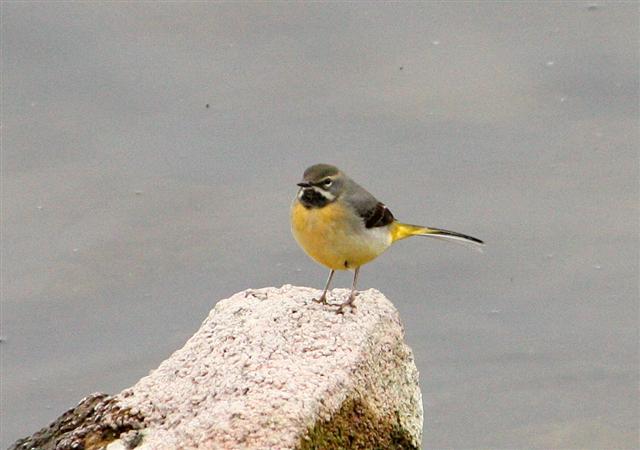
The visit to Draycote was unfortunately made on a very dull day which eventually turned to rain and as I have mentioned in the past my camera doesn't perform at all well in low light but I tried my best and was pleased to see Grey Wagtails on the rocks
.


Grey Wagtail


And this Reed Bunting looking very smart in a hedgerow.


Reed Bunting

A bird which according to all the books is widespread across this country is the Linnet but I never see it on any of my walks close to home so was pleased but not surprised to see it at Draycote which does seem to attract many birds which I would never otherwise see!


Linnet

'There are gayer birds, 'tis true,
On the mossy branches glittering
Gold or scarlet, green or blue,
Let them flit the woodlands through,
But their song to thine is twittering. '
(Ann Taylor)


Every now and again during our visit we heard a Green Woodpecker 'yaffling' in the distance. At the end of our visit, quite late in the evening and after a downpour which had sent most people home, I saw it in a place which is normally very busy. It was so good to be there at that time which emphasised what an absolute haven it is for wildlife when no one is around, I can completely see why some birders go there at daybreak before all the joggers, cyclists etc. appear.

Incidentally if anyone with any influence reads this it would be great if they could put a word in to persuade the powers that be to clean and fill the seed feeders at the side of the hide, they seem to have been abandoned for a long time now, almost as long as the visitors centre!! If I could get to the feeders I would fill them myself!


Green Wodpecker


Well, that's all for now... enjoy the beauty of Nature, wherever you are.

Friday, 25 March 2011

Beautiful Birds but a Barbaric Bird Trap!!


So it is officially Spring! I suspect we could still have some less than Springlike weather but as March 21st has been and gone and we in the UK will put the clocks forward one hour this weekend everything seems to be steadily and happily moving forward.

'Spring to the earth has come; her fountains leap,
In fields of azure pearly clouds repose,
Meek flowers seem along the turf to creep,
And long the lingering twilight softly glows'
(Henry Theodore Tuckerman)

It has been lovely to find and photograph all these colourful Spring blooms during the last week.


Clockwise from top left: Violets, Primroses, Wood Anemone, Daffodils, Wych Elm.


Before I carry on with my planned post I need to tell you about something I discovered yesterday which I found extremely disturbing to say the least.

For the past week or so I have been watching and trying to photograph Yellowhammers. A few years ago I regularly saw and heard them in the hedgerows alongside a disused railway line close to home but for some time now there has been no sign of them there. However a few weeks ago I noticed a small flock about three miles further on from where I used to see them. I have been back several times but had great difficulty photographing them due to the fact they were mainly perched on the roof of an open fronted barn in a field some way from the footpath I was following. After some investigation I eventually found a way into the field but have still had trouble getting close enough to the barn to get decent photos due to there being nowhere to conceal myself.

Anyway, yesterday I tried again and decided for the first time to go around the back of the barn to see if I could get a better view of them from that angle.

As I turned the corner I was absolutely amazed to see what at first sight I thought was a chicken run but as my brain got into gear I realised I was in fact looking at a bird trap complete with two terrified and trapped Magpies!! To say I was shocked is an understatement!

I immediately beckoned to my husband who had stopped on the margin of the field so as not to disturb the Yellowhammers too much. We found how to open the trap and the two distraught and very disturbed birds eventually managed to fly out... and the trap... was somehow upturned ;)

EDIT: The photo which appeared here of the Magpies being released from their living hell has been removed as it seems some people may have viewed it with the intention of gaining information to make these hideous instruments of torture.

I have done some research and found it was a Larsen trap. The Act Against Corvid Traps Campaign says of it ...

'The Larsen trap is a cage bird trap made of wire and a wood framed cage where one live bird (decoy bird, or call bird) ie. crow or magpie, is placed to encourage another bird, not always of similar species, to come down to it. This visiting bird, not knowing its fate, falls through a false floor into a compartment, where it awaits its fate. Although banned in their country of origin because they are viewed as inhumane, Larsen traps are still legal in the UK. It uses a live wild “decoy bird” to attract and trap crows, magpies, jays, jackdaws and rooks. The decoy bird suffers a most terrible existence. Close to the ground it is terrorised by predators, these intelligent birds see its fellow birds brutally killed in front of it. A number end up being found dead through neglect.'

I am fully aware that Corvids are seen by some as a threat to some other birds but there can be no excuse whatsoever for such heartless cruelty to any creature. I am utterly appalled by this barbaric and hideous practice and urge you to please sign the petition against it at the top of my sidebar... I don't think I will ever forget the sight of those poor, terrified and panicking birds imprisoned in that dreadful trap...

Incidentally, if anyone else finds one and there is no evidence of food and water inside the trap a prosecution can be brought. Otherwise, in this country they are unfortunately still legal which is why I would urge you to sign the petition and even put the widget on your own blog. The more publicity the better!

~~~

Thank you for bearing with me :) now back to my original post and as I mentioned Yellowhammers, I think I should post a couple of photos I managed to get, neither of which are good by any means but I will keep trying to get nearer to them.


Yellowhammer

'In early Spring when winds blow chilly cold
The yellowhammer trailing grass will come
To fix a place and choose an early home
With yellow breast and head of solid gold.'
(John Clare)

The following one is on the barn roof


and this Pheasant emerged from inside the barn!


'The beautiful pheasants were fluttering with ease from place to place,
then raising themselves up into an erect position with a majesty that is peculiar to that bird.'
(John Black)


Another bird I saw on the same walk was this Bullfinch and again I couldn't get close enough for a good photo but as I don't see them very often I have included it anyway.


Bullfinch

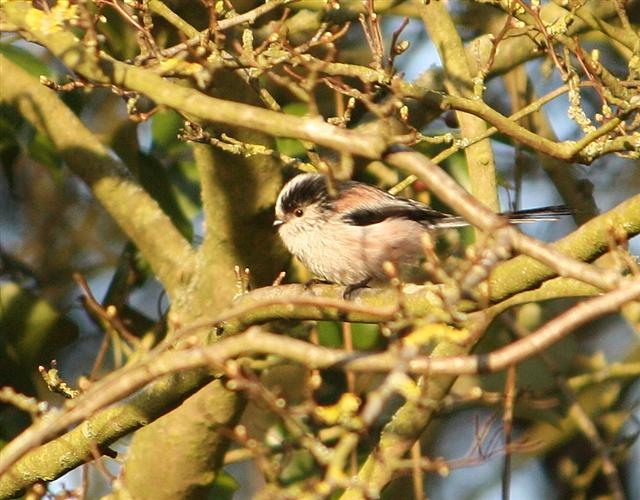
I love to hear the tinkling voices of the Long-tailed Tits as they hurriedly swoop into a nearby tree and just as quickly disappear again.


Long-tailed Tit

The Blue Tits were also busy hunting for insects and grubs.


Blue Tit

When these Bluebells flower I think they will look lovely growing among the moss covering the base of this tree trunk.


Bluebells

There were lots of Rabbits around.


Rabbit

And the lovely song of Robins accompanied us throughout our walk.


Robin

'Sweet, constant, faithful bird,
True to thy land and home !
Whilst other birds seek other climes
Thou never learn'st to roam. '
(Richard Richards)


Now there is more warmth in the sun it is good to see insects emerging again. In the last few days I have had fleeting views of Small Tortoiseshells, Brimstones and Red Admirals but no photos yet. I photographed these Ladybirds in local woodland trying to warm themselves on quite a chilly day last week.


Ladybirds

I often see Dunnocks in the garden but like Wrens they are quite secretive birds, usually skulking around under shrubs and bushes. However, this one seen on our walk, posed long enough for a photo.


Dunnock

Thank you very much for reaching the end of this slightly 'different' post. Please do think about signing the petition, wherever you are in the world your signature is valuable.

Saturday, 12 March 2011

Cheerful Colour and a Continental Cormorant


Several local walks recently showed definite signs that Winter is starting to lose his cruel and icy grip and that Spring's gentle hand is reaching out to make her tentative mark upon the landscape.


'WITH rushing winds and gloomy skies
The dark and stubborn Winter dies.
Far-off, unseen, Spring faintly cries,
Bidding her earliest child arise:
March!'
(Bayard Taylor)


The Snowdrops won't be here much longer.


Snowdrops

'Snow-drop, earliest flower of Spring !
Array'd in spotless white;
O hither come, and with thee bring
What must all eyes delight.
'
(Catherine George Ward Mason)


There were lots of Blue Tits enjoying the sunshine and examining every twig and branch for insects. The more yellow the male's breast is the more he is attractive to the female as the yellowness indicates high levels of carotene pigmentation due to the amount of yellowy-green caterpillars he has eaten. This tells the female he will be good at feeding chicks!


In the West Country the Blue Tit is sometimes known as 'Little Billy Biter' as it is a staunch defender of its nest and will peck at an intruding finger!


Blue Tit


This Great Tit had its feathers fluffed up to keep itself warm on what was a sunny but cold day.


Great Tit


I was thrilled to see my first Violets of the year.


Violets

'The violet in her green-wood bower,

Where birchen boughs with hazels mingle,
May boast itself the fairest flower
In glen, or copse, or forest dingle.'
(Sir Walter Scott)


There is one particular place where I can usually be guaranteed to see our tiniest bird, the delightful little Goldcrest but photographing it is not guaranteed, they are such busy little birds, always moving from branch to branch and tree to tree in their quest for a meal of tasty insects. On this occasion I managed a couple of photos (the one at the top of this post and the following one) although neither are as well focused as I would have liked. This one shows how it earned its name.


Goldcrest


It was also lovely to see the cheerful, golden flowers of the Gorse which looked beautiful in the sunshine against the blue sky. If you look carefully you will see at least three Ladybirds, another sure sign that the year is moving forward.


Gorse

'And over-head in richer gold
The gorse's hardy flow'rs unfold.'
(Mary Russell Mitford)


I was fascinated by this Lichen.


Lichen (Bushy Fruticose)


Lichen is a primitive plant species, strands of algae linked with roots and branches of a fungus that together absorb minerals from the ground and conduct photosynthesis. They first appeared about 400 million years ago!

It can grow almost anywhere, from moist bark to recently cooled lava to frozen rocks. Its body, called a thallus, can be made of different types of fungi and blue-green algae, which will determine how much water it needs or to what it can attach.

Three major types of Lichen grow into different shapes on various surfaces. Crustose grows into unique flat plates that look like mushrooms. Foliose looks leafier, with small, green lobes, and grows in wetter climates beside moss. If you see lichen that resembles viney clumps hanging from branches, it is probably fruticose which is what I think the one above is although I am not sure of the exact identification.

As it is very sensitive to pollution, especially sulphur dioxide, environmentalists use it's presence as a gauge of the cleanliness of the air. Incidentally, Beatrix Potter was one of the first people to postulate that lichens are a symbiosis of fungi and bacteria!


~~~


It is always a pleasure to see Long-tailed Tits flitting from tree to tree. This one was doing an impression of a Treecreeper :)


Long-tailed Tit

'Like feathered dart, the long-tailed titmouse flies'
(Allan Ramsay)


~~~


On our latest visit to Draycote I spotted a Cormorant which looked slightly odd to me. I took several photos of it and did some research when I got home and found it was the Continental Cormorant Phalacrocorax carbo sinensis This subspecies is uncommon in the UK and is usually found inland. While the white head is an indication that it is P. c. sinensis, the only reliable feature that can be used to separate them from the British subspecies, P. c. carbo, is the angle of the gular patch (the yellow patch at the base of the bill). I was pleased I had noticed it was different and found later that it had been mentioned on the Draycote website.


Continental Cormorant (above and below)


Finally, these Daffodil buds were a welcome sight. In the next few weeks, as these lovely flowers open properly, they will be brightening the gardens, parks and roadsides all across Britain, with their colourful and cheerful faces.


Daffodils


Have a lovely weekend and ... enjoy the beauty of Nature, wherever you are.