Monday, 30 July 2012

THE PURPLE EMPEROR: An Audience with His Imperial Majesty!


I received the most wonderful birthday present a few days ago. No, it wasn't the lovely earrings or the pile of Nature books...not more Nature books? Yes, afraid so ;-) No, it was something very, very special, so special that books have been solely devoted to it and pilgrimages are made year after year by its subjects who travel many miles for just a glimpse of its extraordinary beauty. Sumptuous banquets are held for it with white clothed tables bearing many varied and exotic dishes. It is of course the much sought after but very elusive Purple Emperor!

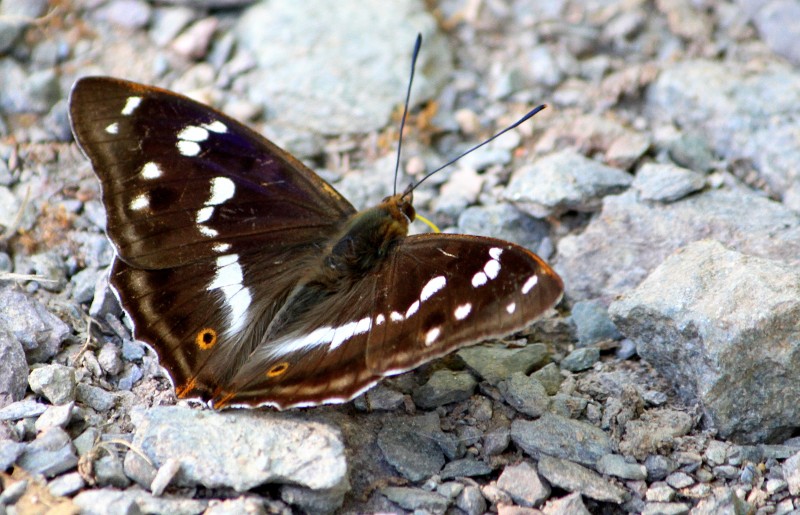
 Purple Emperor (Apatura iris)


When we arrived at our destination which was less than an hour's drive away from home I was well aware that these magnificent, regal creatures held court there but also well aware that to actually see them at close quarters is a rare privilege, so my main quarry was the lovely Silver-washed Fritillary which I had high hopes of seeing. And see them I did...but...every time I spotted one it was a case of 'here's one'. Zoom!...'It went thataway' ;-) So that was the end of that idea. Of course I kept a very close eye out for any sign of His Imperial Majesty but much more in vain hope than any real expectation.


Enter, one half of the Butterfly Brothers! We hadn't been walking for long when we saw someone coming towards us with camera round neck. Now, usually I will smile, say hello and carry on but buoyed up by the sunshine and an eagerness for any help I could get ;-) my usual reticence (shyness!) took a back seat and I asked if he had seen anything interesting. ''Yes, I've seen three or four and got some photos", he said!! 'He must be talking about Silver-washed Fritillaries', I thought. "Of course the best time to see the Emperor is between about 10:00am and midday which is when I saw them", he continued!!! As it was just after 2:30pm I resigned myself to possibly getting a glimpse high in a tree canopy if I was very, very lucky. He told us his brother was further down the track and after wishing me luck we went our separate ways. It wasn't long before Butterfly Brother 2 hove into view, we exchanged smiles and hellos and carried on.


 'Above the sovereign oak a sovereign skims,
The purple emperor, strong in wing and limbs.'
(George Crabbe)


It was a very hot and sunny day and although I find extreme heat very difficult it was such a joy to be out in the sunshine after the last three to four months of continual rain. Meadow Browns were everywhere, thankfully they at least seem to be doing well. As I mentioned earlier I did see Silver-washed Fritillaries but none were interested in settling, they would dart from the forested area into the sunny glade and back again without settling at all.


We were eventually pleased to find a seat to rest on, sip some water and enjoy the surroundings for a few moments and while doing so I suddenly saw a very large butterfly, larger than any other I have seen.. my very first sighting of His Imperial Majesty, The Purple Emperor! Unfortunately, he wasn't interested in a lowly subject like me and regally flew on his way giving me only a fleeting glimpse and not even time to raise my camera in deference!


A pleasant walk produced more Meadow Browns and some Marbled Whites. I have seen and photographed Marbled Whites in five different locations recently, another species which seems not to have suffered too badly this year :-) Eventually we decided to retrace our steps and work our way back to the car park. After a while who should we see coming towards us but Butterfly Brother 2! We had a bit of a chat and he told us that he and his brother travel all over the UK in pursuit of butterflies and had been to Scotland last week to see the Scotch Argus. He also said he does butterfly transects in his own area and voluntary work coppicing etc. in the Winter months. He was clearly very knowledgeable and if I hadn't known better I would have sworn he was a certain blogging friend of mine from Kent ;-)
I asked where his brother was and he said he was lagging behind and as we were talking I spotted Butterfly Brother 1 in the distance. The next moment an enormous bellow rent the air "Purple Emperor! Purple Emperor!"


Needless to say we scurried down that track as fast as we could towards BB1 and there, sure enough, gliding back and forth from one side of the track to the other was His Majesty in all His Imperial Glory! We stood entranced, loyal subjects worshipping at the court of the sovereign! I truly expected him to disappear into the trees never to be seen again, when all of a sudden he dropped to the ground and proceeded to feed, probing between the aggregate with his long and impressive, yellow proboscis in search of salts and minerals.


'Stay near me—do not take thy flight!
A little longer stay in sight!'
(William Wordsworth)


In keeping with their reputation he was completely unperturbed by us and we humbly gathered around him to pay homage. Moments later there was an anguished cry from one of the Butterfly Brothers, "Oh, no, I don't believe it! Bl...y dogs!" "Keep the dogs back, control the dogs!" they both shouted, and amazingly the owners did. I would never have been brave enough to have done that...I could have kissed the Butterfly Brothers :-) Moments later the same thing happened with more dogs and owners and again the BBs triumphed and we continued our reverence.


For all its regal airs this beautiful creature has the most revolting dietary preferences and likes nothing better than a good old helping of dog pooh or fox scat! All of which brings me back to the tables laden with white cloths (His Majesty has been proven to have a preference for white!) each adorned with a fat candle and groaning with delectable dishes bearing such delicacies as king prawns, rotten bananas, horse manure, shrimp curry, crushed grapes, pickled mudfish, honey water and a particular brand of shrimp paste so rancid it had been pronounced unfit for human consumption in the UK! 'The Purple Emperor's Breakfast,' held in the glade of an ancient royal hunting forest, was a contemporary art event arranged by an art gallery as part of an experiment to find out which bait the butterfly was most attracted to. More information can be found here.


We must have worshipped at The Court of his Majesty for getting on for an hour, carefully moving around him and marvelling at the iridescent sheen on his magnificent wings, the hue varying from several shades of blue through to purple as the light struck them from different angles. The even more elusive female is deep brown with the white markings but lacks the purple sheen which the male's dark brown wings show as a result of light refraction.


'O butterfly on whose light wings,
The golden summer sunshine clings.'
(Richard Watson Gilder)


Just as we were wondering whether it would be impolite to leave His Majesty before he had finished dining he rose, replete from his meal and left us without a backward glance. What an encounter it was and one I will never, ever forget. Some people spend a lifetime hunting for this incredible butterfly without success. I feel very, very privileged to have had such a close encounter with His Imperial Majesty.


I hope this hasn't been too long and tedious but I felt The Purple Emperor deserved a post all to himself, there is so much more I could have included! Thank you for indulging me and staying until the end.


N.B. There was a debate as to whether we dared remove the grass which was throwing unwanted shadows on to the butterfly but it was decided it wasn't worth the risk of disturbance. Consequently, and oddly, in some of the photos the butterfly's white markings appear to be on the blade of grass! I assume it is something to do with reflections on the lens.


 Until the next time...enjoy the beauty of Nature, wherever you are.

Thursday, 12 July 2012

Snatching Some Light for the Marbled White!


Often, during a 'typical' British Summer, we are hard put to snatch the occasional warm and sunny week, sometimes it is just the odd day here and there but this year it has been difficult to find even an hour or two of nice weather! It is immensely disappointing for those of us who like to get out in the countryside with our cameras. But if it has been disappointing for us it has been devastating for our wildlife with ground nests washed away, nests in holes in river banks flooded out and much needed grubs and insects washed from foliage resulting in many dead nestlings. Unfortunately, many people too have had their homes flooded out, some more than once...truly devastating! And while we in the UK suffer the effects of extreme weather, many abroad are also experiencing devastation with baking temperatures and dreadful, damaging fires. Whether these extremes are anything to do with global warming will no doubt be the subject of much discussion and, I suspect, little conclusion.

I have managed to get out with the camera from time to time but have been dismayed by the small number of butterflies and Odonata seen in comparison to other years. This Common Blue was photographed in the rain so not the best of photos.


Common Blue Butterfly


 This one was taken in much better conditions! 


 '[Butterflies] That flash like meteors through the shady bowers,
And rest like broken rainbows on the flowers,
Themselves more rich and beautiful of hue
Than any flower that's nourish'd by the dew.'
(Unknown)


The Song Thrush, with its predilection for snails, will be one bird which has seen some benefit from all the rain! This one was seen in fading light so the photo has been lightened a little.


Song Thrush


When I was coming to the end of a walk, again in not very favourable conditions, I spotted what I thought was a fledgling among the grass but quickly realised it was this handsome fellow.


Common Toad

'The world has held great Heroes,
As history-books have showed;
But never a name to go down to fame
Compared with that of Toad!

The clever men at Oxford
Know all that there is to be knowed.
But they none of them know one half as much
As intelligent Mr Toad!'
(Kenneth Grahame)


Something which, by any stretch of the imagination, couldn't be called handsome but is nevertheless impressive, is this fearsome looking Yellow Dung Fly. Had I found it in the place which its name suggests it wouldn't have found its way on to my post but luckily it was on a flower. They do feed on pollen but it was most likely to have been hunting for smaller insects to prey upon.


Yellow Dung Fly


Not quite as fearsome from this angle!


This Grey Squirrel was intrigued enough by me to pose for a photo.


Grey Squirrel


A walk along this stretch of a local canal a few weeks ago should have produced a wealth of Odonata. The vegetation is usually teeming but on this occasion absolutely nothing at all was seen!


More recently on a different stretch of the canal I have seen a few damselflies but nowhere near as many as other years. These were in the classic 'wheel' (copulation) position.


White-legged Damselflies


One rare, fine afternoon recently (the sun only lasted for about an hour!) I decided to look for the butterfly with which I started this post, in a location within easy walking distance of home. I have seen them there in the past and was pleasantly surprised to find them straight away.


Marbled White Butterfly (female)

'A rustle of corn-leaves;
a tinkle Of bells on the hills;
a twinkle Of sheep in the lowlands;
a bevy Of bees where the clover is heavy;
A butterfly blundering by, —
And that is July!'
(James Newton Matthews)


I wasn't able to get one with wings fully open. I do think they are very attractive butterflies!


I have no idea why but the next little insect is one I always enjoy finding each year and I nearly always see one on the same clump of Ox-eye Daisies. It's my old friend the Fat-legged Beetle (Oedemera nobilis).


Fat-legged Beetle


Finally, they say this is the weather for ducks so I thought I would finish with Mrs Mallard


Mallard Duck


and baby mallard.


Mallard Duckling


Until the next time...enjoy the beauty of Nature, wherever you are.

Saturday, 9 June 2012

Yellow Wagtails and Green-winged Orchids!


A couple of weeks ago we visited a local wildflower meadow in the hope of seeing some orchids but found we were slightly too early for the ones which grow there. About the only thing found of interest was this Sloe Shield Bug also known as Hairy Shield Bug due to the fine hairs covering its abdomen.


Sloe Bug

However, while we were there we met a couple who asked us if we had heard of Draycote Meadows as they had been the week before to see the Green-winged Orchids and that it was well worth a visit. We said we knew Draycote Water well but that although we had heard of the meadows we had never been sure where they were. They gave us directions but cautioned us that they were not easy to find. As we realised we were cutting things fine in terms of seeing the orchids at the peak of their flowering period we decided to go the next day. To say it was a difficult place to find was an understatement! A journey which should have taken around thirty minutes took twice that time, it was extremely difficult to find and we made many wrong turns and if I hadn't eventually spotted just one other car in the gateway we would have sailed straight past!

Anyway, having finally tracked down this SSSI (Site of Special Scientific Interest) we had no trouble finding the flowers and what a lovely sight they were! Incidentally, isn't it sad that what fifty or so years ago would have been considered just a typical flower filled meadow is now seen as quite unusual and in need of special management and protection? 


'And 'tis good to go forth among scenes like these,
Amid music and sunshine, and flowers and trees,
If 'twere only to waken the deep love that springs
At the sight of all lovely and innocent things.'
(Anonymous)


Although the orchids would have looked a little better a week before, they were still very pretty. As is so often my luck though the minute we stepped into the meadow the sun disappeared so I took some photos but decided to do a little exploring and follow the bridleway for a while. Thankfully, it wasn't long before the sun returned :-)


So we retraced our steps and returned to the meadow to try and get some sunnier photos. On the way we saw this little fellow.

 
 Rabbit 

'Some rabbits have bright shiny noses
I'm telling you now as a friend
The reason their noses are shiny--
Their powder puff's on the wrong end'
(Unknown)


Once widespread, there has been a steady decline of the Green-winged Orchid since the 1950s due to agricultural 'improvement' of its grassland habitat. It is sadly, very scarce in some areas of the UK such as the south-west, and in Scotland can only be found in one small area on the west coast of Ayrshire.


Green-winged Orchid (Anacamptis morio)

The green 'wings' of this lovely flower are not always obvious but at least a hint of green can usually be seen in a few plants. The flowers can vary from a paler pinkish mauve to deeper purple and sometimes even white. Here's a closer view.


Orchids are dependent on a fungus which allows them to germinate and obtain nutrients and to compete with other plants. Therefore they are extremely vulnerable to fungicides, fertilisers, lime and ploughing. The Green-winged Orchid depends on infertile or nutrient poor grassland.


 'Flowers, lovely flowers! ye are to me
Most dear and precious things;
Nature's soft pencil over ye
Its brightest colouring flings.
Ye seem to me, though blooming here
Bright beings of another sphere.'
(Mary Ann Gray)

After we had taken our fill of these lovely flowers we decided that as we were so close we would round off our trip with a visit to Draycote Water. It was a Sunday and a nice day so I knew it would be very busy there and I wasn't surprised that there wasn't much to be seen in the way of bird life. There are, however, always plenty of Pied Wagtails flitting around hunting for insects.


Pied Wagtail

These Canada Geese allowed me to try an in flight shot which I usually tend to avoid.


Canada Geese

I am not overly knowledgeable when it comes to gull ID especially with all the various stages of plumage they go through but I think this is a first Winter Common Gull which, by the way, in my experience is nowhere near as 'common' as the far more often seen Black-headed Gull. Mind you, whoever named the different gulls could have done a lot better I think especially when they named a gull with a brown head the Black-headed Gull ;-) But I digress! If my identification is correct I am slightly confused as to why it would still be at the 'first Winter' stage at the end of May! Could it be due to the poor Spring weather this year?

EDIT: Thank you very much to Warren and John for establishing it is a Common Gull in 1st Summer plumage. And no John, your info wasn't at all boring, I found it very helpful. Both of your contributions were much appreciated!


Common Gull (Ist Summer plumage)

There is always an abundance of small flies at Draycote sometimes to the extent that it makes a visit very unpleasant, however, they are very attractive to many of the birds particularly the wagtail family and consequently the lovely Yellow Wagtail can often be seen there and this time was no exception.


Yellow Wagtail


'Oft, in the sunny mornings, have I seen
Bright-yellow birds, of a rich lemon hue,
Meeting in crowds upon branches green,
And sweetly singing all morning through.'
 (Denis Florence MacCarthy)


Finally, another look at the lovely wildflower meadow.


Until the next time...enjoy the beauty of Nature, wherever you are.

Friday, 1 June 2012

Butterflies, Birds and the Beautiful British Countryside


After the rather gruesome tone of my last post this one returns to my gentler style. It has been so nice to be able to get out and enjoy the warmth and sunshine in the last couple of weeks but sad that we seem, in the last few days, to have returned to dull and rainy weather once again, such are the delights of living in the UK!

The following photo is one which was left over from a walk on one of the few decent days we had in April. I wasn't the only one who was enjoying a brief spell of sunshine.


Great Tit

Bluebells are well past their best now but were still looking lovely here just a couple of weeks ago when I photographed some lining each side of an old bridleway.


Bluebells


'There is a silent eloquence
In every wild bluebell
That fills my softened heart with bliss
That words could never tell.'
(Anne Bronte)


As regular readers will know, I love butterflies and with the spell of very early good weather in March my hopes were high that this year would be much better for them than last. However, with the dreadful weather throughout April and much of May those hopes were soon dashed. The sunshine and warmth of the last couple of weeks though has seen a rise in fortune for these little jewels of the air and, although I have not seen as many in my area as I would have liked, I have seen a few such as the lovely Orange Tip, one of the first butterflies to be seen in the Spring which hasn't overwintered as an adult. One of its main food sources is the Bluebell.


Orange-tip Butterfly (male)


And this lovely creature is the female, isn't she pretty?

 
Orange-tip Butterfly (female)


The countryside is looking beautiful after all the rain.


Another photo left over from the end of April is this one of a Blue Tit  with a caterpillar in its beak, I just managed the one quick snap before it flew off to feed it to its nestlings.


Blue Tit

'The little Titmouse! the little Titmouse!
What a comical fellow is he!
With his head awry, and his half-closed eye,
As much as to say "I see—
I see the maggot within the green bud;
You cannot, although your sight may he good.
I'm sharper than you, for I'm searching for food,
And I'm hungry very—chee! chee!"'
(Unknown)


Everywhere I go at the moment I seem to flush Pheasants, sometimes I don't know who is the most startled! Just occasionally though I see them before they see me. It was nice to see this pair together but unfortunately they were at a distance and in poor light.

  
Pheasants (male and female)


This male was a bit closer. What a handsome fellow he is!


Pheasant (male)


A bird I don't see very often and which is on the red list of 'birds of conservation concern' is the Grey Partridge. I saw this one at the very end of a walk, I flushed it and its mate and they flew to the end of the field where I managed to get this quick photo just before it disappeared after its mate under a hedge.

 
Grey Partridge


Buttercups may be a common sight in the British countryside but no one can deny they are a cheerful sight especially on a sunny day with their golden heads nodding in the breeze.


Buttercups

'The buttercups with shining face
Smile upward as I pass.
They seem to lighten all the place
Like sunshine in the grass.'
(Sarah J. Day) 


The Speckled Wood is unique among British butterflies, it can overwinter in two stages as both a larva and pupa. This means there is a mixed emergence with adult butterflies on the wing from April to September, with a few adults being seen as early as March or as late as October, especially in the south. I saw this one appropriately, given its name, in woodland.


Speckled Wood Butterfly


I was hoping to get some photographs of the Brimstone Butterfly but although I saw several I couldn't persuade them to stop and have their photos taken. I did see this pretty little Green-veined White though.


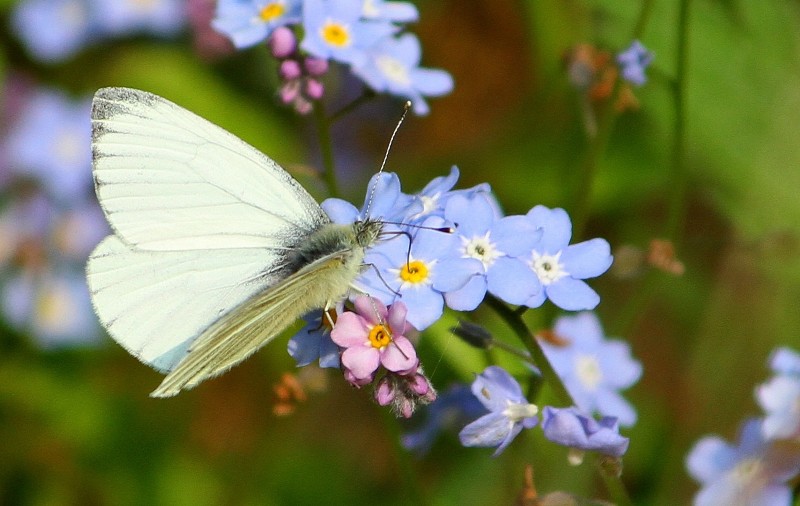
Green-veined White Butterfly

'But lo! a white and spangled thing
Was sporting there on tiny wing;
In haste from flower to flower it flew,
And sucked from each the honied dew.'
(Louisa Segrave)


Finally another butterfly and this time one I had never seen before, the Dingy Skipper and in my opinion looking not at all dingy.

Dingy Skipper


Well that's all for now except to say that on the 23rd of May I heard my first Cuckoo of the year, they are so much less common than they used to be here so it was a real thrill to hear and get a brief glimpse of it in a tree just yards from me.

Until the next time...enjoy the beauty of Nature, wherever you are.