Monday, 17 January 2011

Winter Visitors


After an unintentional break from blogging I have at last managed to put a post together. My apologies to regular readers and to all my blogging friends whom I have been unable to visit lately.
I will do my best to catch up with you all as soon as I can. I hope everyone had an enjoyable Christmas and my very best wishes to you all for a healthy and happy New Year. I would also like to thank my blogging friends who have contacted me with expressions of concern at my absence, you know who you are and I have been immensely touched by your messages, it has meant a great deal to me to know that people care.


It’s all because life won’t wait,
before you know, it’s Christmas here.
And look, in a minute,
suddenly it’s New Year.

Snow is falling, deeper – deeper.
Maybe, with that same stride
in that same tempo,
with that same languor,
Time’s going by?

(Boris Pasternak)


With some rather depressing and ongoing family problems,
Christmas preparations, the festivities themselves, and my husband going into hospital for an operation just after Christmas I haven't been able to pay much attention to the computer for some time! However, my husband came home a week ago and is progressing steadily, he is not allowed to do much for a while which of course means I have a lot to do at the moment but hopefully things will get back to normal before too long.

Well, what weather we have all experienced recently! After just a small amount here to start with, we eventually had our fair share of very heavy snow which hung around for quite some time. The last few days have been much milder though and one or two have felt almost like Spring with lots of birdsong and the sound of Blackbirds establishing their territories. While carrying out my duties as chief dog walker, since my husband has been incapacitated, I have been keeping a lookout for any wildlife and over the last few days have seen lots of Robins, Sparrows, Blackbirds and Chaffinches darting in and out of hedgerows, Pied Wagtails strutting along pathways and yesterday I saw a small flock of Long Tailed Tits flitting from tree to tree. I have also seen many Grey Squirrels scurrying up and down trees. Unfortunately, I can't manage a large dog and a camera at the same time so wasn't able to get any photos.

I realise I haven't mentioned the birds in my garden for some time so thought I would show a selection of photos taken over Christmas but regrettably through the (not too clean!) window.

Collared Doves are regular visitors to the garden.


Collared Doves


It is amazing to think that before 1955 there were no Collared Doves breeding in Britain and now they are one of our most common birds probably in some part due to their lengthy breeding season of March to October. They are most often seen in pairs and remain loyal to their mate.


Chaffinches visit the garden in large numbers in Winter but not so much in Summer.


Chaffinch (male)


Chaffinch (female)


Some time ago I bought a couple of hanging feeders with adjustable roofs.


Goldfinch


The idea being to not only keep the food dry but also to deter the larger birds. I always put food in various places around the garden so that all visitors are well catered for but that doesn't stop the bigger species from devouring more than their fair share. I should of course have realised that with Starlings, where there is a will ... there is always a way!


Starlings

'An old huntsman named Maurice had a trained starling which, if its master said,'Starling, where are you' would immediately answer,'Here I am !'
This bird was a great delight to the son of one of the neighbours, a little boy called Charles, who often came to pay it a visit.
One day, when he came to see it, the old huntsman was not in the room.
Charles caught the bird, put it into his pocket, and was moving towards the door when in came Maurice, who, thinking it would please the child, called as usual, ' Starling, where are you?'
And the starling, from its hiding-place in the boy's pocket, cried with all its might,' Here I am!'

'Be a theft cunning as it may,
It soon comes to the light of day.'
(J.M.C.)


Greenfinches are also regular visitors to the garden and I have noticed they can be quite aggressive towards other birds while vying for position at the feeders.


Greenfinch


Although this one happily shared the peanut feeder with a Coal Tit


Greenfinch and Coal Tit


It is not always easy to get photos of the little Coal Tits as they don't stay still for long but in the snow and ice they stayed at the feeders longer in their frantic attempts to fuel their tiny bodies against the bitter cold weather.


Coal Tit


I think one of the most colourful and delightful visitors to the garden is the enchanting Goldfinch which is guaranteed to brighten the dullest day with its tinkling call and exotically coloured plumage.


Goldfinch

In the Winter I always make sure I put plenty of apples out for the birds and this year I was hoping to attract some of the Waxwings which have been reported in so many parts of the UK including just around the corner from me. Unfortunately I haven't been fortunate enough to see any so far but the apples are particularly welcomed by the Blackbirds. Look how brightly the orange beak and tongue of this male show against his black feathers and the snowy background!


Blackbird

'The blackbird is a bonny bird
That singeth in the wood
His song is in the evening heard
When the red cow chews her cud ...

O bonny is the blackbird still
On top of yon fir tree
On which he wipes his golden bill
And blithely whistles he.
(John Clare)


A very occasional visitor to the garden is the Stock Dove, a slightly smaller and more timid bird than the rather similar and much commoner Wood Pigeon.


Stock Dove


Finally another frequent visitor all year round is the bird which I started this post with, the pretty little Blue Tit.


Blue Tit

'Where is he that giddy Sprite,
Blue-cap, with his colours bright,
Who was blest as bird could be,
Feeding in the apple-tree.'

(Samuel Taylor Coleridge)

Well that is all for now and I shall try to catch up with you all as soon as I can, thank you for bearing with me and until the next time... enjoy the beauty of Nature, wherever you are.

Wednesday, 17 November 2010

Oh, Deer!


A few weeks ago we took an afternoon walk in a favourite local spot. Despite taking the route many times I had never been lucky enough to see the wild deer which were reputed to be there and in fact on this occasion I had completely forgotten about the possibility of seeing them. As we strolled in the October sunshine, enjoying the beautiful surroundings, I looked to my left and noticed what I thought was a large log in the distance, halfway up a grassy slope. At the time I thought nothing of it being more intent on looking for birds or the odd, late butterfly.


'Where are you O Wild Deer?
I have known you for a while, here.'

(Shams al-din Hafiz)


We walked on for a while and eventually turned to our left and slowly climbed the steep incline. While stopping to catch my breath halfway up I looked through the binoculars and realised the 'log' had multiplied and that I was actually looking at a small group of three Roe Deer. Completely by chance, I had found them, at last!


Roe Deer (Capreolus Capreolus)


'Up the steep hill we'll zigzag through heather and moss;
We'll dive into the glen and the steppingstones cross;

We'll couch with the red deer, we'll rise with the roe;
We'll rest when the sun's high, go fast when he's low.'

(James Henry)


Of the six species of deer which live wild in Great Britain only the Roe Deer and the Red Deer are truly native having been here since before the Mesolithic Age. Forest clearance and over hunting led to them becoming extinct in England by 1800 although they remained in wooded patches in Scotland. During Victorian times, reintroduction schemes led to their natural spread and an increase in the planting of woodland and forests in the 20th century, has meant that Roe Deer are widespread and abundant in the present day.


There was something which I found very noticeable throughout the entire time we were watching the deer. Our walk had taken us along the valley below them, then up the steep hill at the side of them and finally along the grassy route above them. So in effect we walked full circle around them and at all times, after I first spotted them, at least one of the party was watching us intently while the other/s grazed. I strongly suspect they had been watching us long before we realised they were there!


When alarmed, bucks (male) and does (female), give a short bark, which is often repeated. During the rut, the doe makes a high pitched piping call to attract the buck who in turn makes a rasping noise as he courts the doe.
The rut, or breeding season occurs between mid-July and mid-August. Prior to this bucks become aggressive and maintain exclusive territories around one or more does. Fights between bucks can result in serious injury or even death! The winner will then take over the loser's territory or attendant doe. Bucks usually mate with several does and does mating with several bucks has also been noted. Courtship involves chasing between the buck and the doe for some time until the doe is ready to mate.


Although mating occurs in late summer, the fertilised eggs do not start to develop immediately. This phenomenon is known as delayed implantation (embryonic diapause) and is unique among hoofed animals. It is thought to be an adaptation to avoid giving birth during the harsh Winter months.


The fertilised egg remains ‘floating’, unattached within the uterus for five months. During this time the cells of the embryo divide and multiply very slowly. Unlike those of other species (including those with delayed implantation), the un-implanted embryo controls its own growth. At the end of December or early January, when it is little more than 0.3mm long, the foetus is genetically programmed to reactivate from its period of delayed implantation. It sends a message to the mother by way of a protein unique to the Roe Deer. When the mother receives this message a cascade effect of hormones begins which enables the embryo to expand rapidly. After a short period of very fast growth, the embryo attaches itself to the inner wall of the uterus. Normal foetal growth follows then, for a further five months.

The doe will typically produce two young during May or June of the following year when the weather should be more hospitable. The young stay with their mother for around 12 months. I think it is more than likely that the three I saw were mother and her two youngsters.


'When from my path the startled roe-deer fly,
In their soft glance I see thy gentle eye '

(Unknown)


Roe Deer are active 24 hours a day but most active at dawn and dusk. They also spend long periods 'lying up' which is where the deer lies down to ruminate between bouts of feeding.


I had great difficulty
finding any verse about deer which didn't concern hunting. I think it is a great shame that these lovely creatures are not celebrated for their beauty rather than the so called sport they provide for man. However, this extract from a poem written by the publisher of the Rotarian newspaper in Concorde Massachusetts in 1950 after he had read one such poem sums up my feelings perfectly.


'The beauty they bring

To their natural haunts

For all who are privileged to see,
Is full reason it seems
To let them live on

Quite alone, quite alive, and quite free.'


(Samuel G. Kent)


I felt immensely privileged to watch the Roe Deer for so long. These normally shy animals allowed me to observe them openly for quite some time before eventually taking to their heels and disappearing down the hill but not before all three turned and gave one last look as if bidding goodbye.


Until the next time... enjoy the beauty of Nature, wherever you are.

Friday, 5 November 2010

Closer to Home


As I had my little twitch :) with the Lesser Yellowlegs last week I was eager to tell you about it the next day which was when I was originally planning to publish this post. So, after all the excitement of last week, and later than intended, this is one of my more usual posts.

I was reminded a couple of weeks ago that the most magical moments in Nature don't always concern unusual sightings, sometimes the most 'ordinary' creature can deliver something very special.

I was walking close to home when I noticed a Carrion Crow perched on a fence post at the edge of a field. As I approached I expected it to fly away, I started to take photos mainly because I hadn't seen much else of interest during my walk. To my surprise the Crow was completely unperturbed by my presence, as I stood within arm's length of it, clicking away with the camera. For a few moments it seemed that I was totally at one with this bird which seemed to have a certain wisdom in its eyes.


'Crows can recognise individual human faces and hold a grudge for years against people who have treated them badly. This ability – which may also exist in other wild animals – highlights how carefully some animals monitor the humans with whom they share living space.
John Marzluff and colleagues at the University of Washington in Seattle prepared six masks from casts of people's faces, then wore different masks to capture crows in each of four locations. In each case, they found, the crows recognised and scolded whichever mask they had seen when they were captured, and ignored the others.'

(Bob Holmes, New Scientist.)


Unfortunately, all too soon, the spell was broken by the approach of a group of people with dogs and my muddy beaked, new friend flew away.


In a Japanese city, Carrion Crows have discovered how to eat nuts that are too hard to crack. One method is to drop the nuts from a great height on to a road. Some nuts are particularly tough, so the Crow drops it among traffic. To retrieve the nut without getting run over, some birds wait by pedestrian crossings and collect the cracked nuts when the lights turn red! You can see this behaviour here.

~~~

It was lovely to see a butterfly recently, after not seeing any at all for some weeks when the weather inevitably turned from late Summer into Autumn. I suspect that is the last one I will see until next year now.


Red Admiral Butterfly

The hedgerows were laden with fruit waiting to provide a tasty meal for the birds.


Rose Hips

'Autumn! soul-soothing season, thou who spreadest
Thy lavish feast for every living thing,
Around whose leaf-strew'd path, as on thou treadest,
The year its dying odours loves to fling
Their last faint fragrance sweetly scattering.'

(Bernard Barton)


Hawthorn Berries


Blackberries

As I walked around the local reservoir I saw a number of Goldfinches flitting through the trees and hedgerows which line the path. By the time I realised my camera battery had run out of power and replaced it with the spare, most of them had dispersed and I only managed to get a very distant photo of one examining a solitary berry, while another sat below it presenting me with a bottom shot!


Goldfinch

As is usually the case there was nothing of great interest on the reservoir itself. About the only birds I have ever seen on the water there are Mallards, Grey Herons, Cormorants, Mute Swans, occasionally Great Crested Grebes and of course gulls.


Black-headed Gulls

On this occasion, apart from the usual Black-headed Gulls, I did see this one which I think is a Lesser Black-backed Gull, if you think I have problems identifying waders I have even more difficulty with gulls!


Lesser Black-backed Gull

And here with a Cormorant.


Cormorant and Lesser Black-backed Gull

A Grey Heron was patiently watching the water, hoping to spot its supper.


Grey Heron

'Hermit-like, he stands and muses,
Until he seems to be,
Moveless in dream-like silence lone,
Some spectre bird, or sculptured stone,
Or stump of scathed tree.'

(Bernard Barton)


Surprisingly there were no ducks at all on the reservoir, not even the usual Mallards but I did see some through the hedge on the river


Mallards (male, left and female)

and it was nice to see a couple of wildflowers blooming in October.


White Campion


Comfrey

I will finish with this lovely Robin singing its heart out in the way I love to see them most.


Robin

'Bird, are you singing to me ?
Singing of wood and of dell ?
Of the flowers I used to take,
Of the nut-trees I would shake,
Of the fishing on the lake.'

(Menella Bute Smedley, Fanny Wheeler Hart)


Have a good weekend and ... enjoy the beauty of Nature, wherever you are.

Tuesday, 26 October 2010

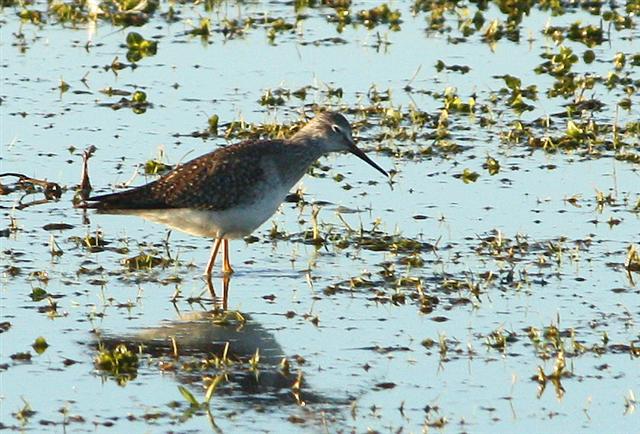
I Turned into a Twitcher and Bagged a Juvenile Lesser Yellowlegs!


When I started this blog I made a point of saying I was not a birder and that I just love Nature and beauty in all its forms. Somehow though, somewhere along the line, it gradually happened! I think that someone who breathes, sleeps and (sometimes, quite literally) dreams birds has to eventually admit that they are indeed a birder and after all, I have watched birds since I was a child, even writing a book on birds for a school project at the age of twelve. However, I have never considered myself to be a twitcher. A twitcher, as we know is someone who will travel long distances, sometimes from one end of the country to the other in pursuit of a rare bird which has been sighted and whose location has been transmitted on the bush telegraph to fellow enthusiasts who then proceed to converge on said bird to add another tick to their list.

I would find no pleasure in dashing all around the country just to add a bird to my list and in fact I think there is no greater pleasure than spotting a bird in one's own garden which has never been seen there previously. However, when I hear there has been an unusual bird seen within twenty five or so miles of my home, I have to admit to being tempted to go and take a look, purely because it is a bird I have not seen before and hopefully to get a photo of it.

So when I heard there had been a juvenile Lesser Yellowlegs (Tringa flavipes) at Port Meadow Oxford for the last week or so, I thought it was worth turning into a twitcher for the day and giving it a try. Of course regular blog visitors who remember my failed attempts, this year and last, to see the Lesser Scaup at Draycote Water (a slight case of twitching there too I suppose!), will not be surprised to read I had no confidence at all in my ability to actually find the bird, even if it was still there!

Imagine my surprise then, when after leaving the car in the free car park, we walked into the meadow and towards the flooded area and within moments spotted it! The only snag was that the sun was in the wrong place for decent photos but I had a try (how could I not?) and below are the best I could manage.


Not being overly familiar with waders and completely unfamiliar with this particular one, I was a little worried as to whether I had found the 'right' bird, however...


When we first arrived there was just one other person taking photos and as we approached he packed up his gear and left. I had also noticed a small group of people on the opposite side of the flooded area and when I finished taking my photos I turned round and found the group had walked round to the side we were on and had their binoculars, scopes and cameras all focused on 'my' bird. So, in slight fear and trepidation of showing my ignorance, I asked if I had the right bird and was told it was indeed and one of the party said he had even seen one before, up in Scotland!


It was a shame I was always shooting into the sun as the photos don't adequately show the beautiful deep yellow which gives this lovely wader its name. I think the one at the top of the post gets closest.


Outside the breeding season Lesser Yellowlegs forage in shallow water, picking at prey on or just below the water's surface. They scythe their bills back and forth in the water stirring up prey like an Avocet.


This visitor from North America bobs the front half of its body up and down and the most common sound which may be heard is a two-note flight call. During the breeding season, insects make up the majority of the Lesser Yellowlegs diet. The rest of the year, they also eat small fish and crustaceans.


Well that is it for now, I hope I haven't bored you too much by focusing on just one bird and thank you for indulging my excitement. I rather enjoyed 'turning twitcher ' for a day but now I will go back to being a birder...until the next time I hear of an unusual sighting not too far from me :) Enjoy the beauty of Nature, wherever you are.