Wednesday, 30 January 2013

A Waxwing At Last!


All I wanted for Christmas...was a Waxwing...but I was disappointed! Several times, during December, I spent time locally, following up reports of sightings of small flocks of these much sought after and charismatic birds. The last time there was an irruption of Bohemian Waxwings in the UK in the Winter of 2010/11 many, if not most, of my blogland birding friends were lucky enough to see them but sadly I missed out completely so when it became clear, late last year, that this was to be another 'Waxwing Winter' I was determined to make a concerted effort to try and find them.


Bohemian Waxwing

'But, oh! my spirit burned within, 
My heart beat full and fast!
He came not nigh—he went away— 
And then my joy was past.'
(Acton Bell)


Irruptions of birds occur when the food source in their own area is scarce. Waxwings feed primarily on berries and fruit and the crop there this year was poor. Consequently large numbers arrived in the UK (probably not as many as 2010/11) hoping to take advantage of the bounty here. Unfortunately though our own berry crop has also been poor this time and many of the larger flocks (their preferred way to travel around) of Waxwings have broken up and formed much smaller groups, flying further away from the east coast and across the country in search of dwindling supplies of berries. They will take insects on the wing if available but as I said their preference is berries, Rowan, Hawthorn, Pyracantha etc. They will also eat apples and since late Autumn I have been spearing them onto the branches of trees in my garden in the hope of attracting some but with no luck so far.


My quest to find them before Christmas was not to be. I always managed to just miss them. Most of these sightings were only a matter of four or five minutes' drive away so when, a couple of days before the recent snow arrived, I read more reports of a very small group being sighted in the same area, the hunt was on again. I was scanning the sides of the road for any likely trees or hedges but there really were very few berries to be seen. As we passed one tree I did a double take when I spotted a bird high in the branches but decided it was probably a Starling particularly as I was really looking for a small group of birds rather than just one.


 'Powerful was the beauty of these birds.
It boomed like a struck bell in the silence deep and hot.'
(Edna St. Vincent Millay)


Carrying on searching around the area produced nothing at all and as it was getting late and the light was starting to fail I decided to call it a day. Going back the way we had come I again spotted, high in a different tree, a Starling sized bird...with an unmistakeable crest!! I had found my first ever Waxwing :-) which I think probably was the same bird I had seen earlier. It may only have been one but how thrilled I was! I took a silly amount of photos knowing it was a difficult subject with it being late in the day and as usual not really close enough for my 50-250mm lens. After that I just enjoyed watching it for a while through the binoculars.


Bohemian Waxwings are so called due to their presumed origins from Bohemia and habit of travelling in nomadic flocks. Waxwing refers to the wax like tips on the ends of the secondary feathers which resemble drops of sealing wax. Males which show more red wax are preferred by females. As I have mentioned they normally travel together, usually in flocks of around 50-300 but sometimes in excess of 3,000! When feeding in flocks they will eat in shifts, one group at a time, so that all get their fair share. They really are fascinating birds. When courting, male and female can be seen passing berries back and forth, often for quite prolonged periods. This behaviour has also been observed in social situations where a berry is passed back and forth along a whole row of Waxwings and very unusually they even practise their sharing ritual before fledging! There are no records of them breeding in the UK. Some birds have been observed in this country as late as early May. Their lifespan is around 5 years but there are records of them living until the age of 12.


'Trilling Bohemian waxwings.
Enhancing the winter fragrance of
a crab apple tree of frozen fruit.
Trilling in a most joyous song of
Happiness.'
(Jim Smart)


The Latin name is Bombycilla Garrulus. Bombyx (silk) and cilla (tail) which refers to the bird's soft and silky plumage* and garrulus meaning noisy. Collective names for them are an 'earful' of Waxwings and a 'museum' of Waxwings. Old texts have described it as an 'un satiable' bird and a 'lazy and inert fellow whose only accomplishments are within the art of eating'! Given how far and wide they fly to search for food I don't agree with the view that it is 'lazy and inert'. However, it will eat its weight in food each day. Sometimes, when berries have fermented, this has unfortunate consequences causing them to fly in an unstable manner and making them vulnerable to predation and accident. The artist and naturalist John James Audubon would sometimes pick up drunken Waxwings from the ground to use in his illustrations.


*
 (John James Audubon's 'The Birds of America', 1827-1838.)


So, although I didn't get a Waxwing for Christmas I did get one for the new year. I would love to have seen more than one, to have been closer, for there not to have been twigs in the way and to have seen it earlier in the day when conditions were better but I did see one and that's what really matters :-)


Until the next time...enjoy the beauty of Nature, wherever you are.

* I am indebted to Marianne for the following extra information:

'The idea that 'cilla' means 'tail' comes from a misunderstanding of the scientific name of the wagtail genus, Motacilla. This means 'little mover' (the 'illa' part being a diminuitive), but was taken by some writers, undertandably enough, to mean 'moving tail'. As a result, 'cilla' has since been used to mean 'tail' in several scientific names, including Bombycilla, but really Bombycilla would mean 'little silky thing'.'

Sunday, 13 January 2013

Using Up the Leftovers!


I hope everyone had a lovely Christmas and that you will all have a wonderful 2013! As Christmas has only just gone I'm sure many of us have been using up the leftovers whether it be chocolates, snacks or pieces of cheese growing smellier by the day but in my case, as well as all of those it is also photos which never quite made it to the blog. Once these have been 'eaten' up the cupboard will be bare and I will be hoping for better things than I found on my latest walk which was just about nothing, even the usual Winter Thrushes were nowhere to be seen or heard and the ones I saw on previous walks were too flighty for photos. Hopefully, this year will be a better one in every way and I will be able to get out with the camera more often and let's hope all of us in the UK will have much better weather this year too...it surely couldn't be any worse...could it? 

You will probably be relieved to know that the butterflies in this post are the last I will inflict on you until the Spring ;-) These lovely little Small Coppers were seen during my visit to Aston Rowant National Nature Reserve in August.


Small Copper Butterfly

 This butterfly,
Seems as if loth to stir,
so lazily
It flutters by.

(Alfred Billings Street)


The next three were also seen at Aston Rowant, it is a great place for butterflies and the only place I managed to photograph a Brimstone this year which shows what a bad year it was, unfortunately though it was in the wrong place so I haven't included the photo here.


Meadow Brown Butterfly


Ringlet Butterfly


Gatekeeper Butterfly


This one was seen more locally.


Green-veined White Butterfly


I had never seen a wild black rabbit before but spotted this large specimen at another Nature reserve in the late Summer.


Rabbits


A little rabbit, basking in the sun.
Dark night has ended, day has just begun.
The blackbird trills his morning song of love,
And green leaves cascade down from clouds above.
All nature's wide awake – and it seems funny to be a gentle, friendly little bunny!


((Sir) Patrick Moore...In Memoriam...1923-2012)


And this juvenile Coot was spotted looking comical as only Coots can at yet another Nature reserve.


Juvenile Coot


I included the next photo just to show that even the humblest fly can look pretty in the right setting.


Lucilia sp.

'This world surely is wide enough 
to hold both thee and me'
(Laurence Stern)


The next two butterflies were found locally, much later in the year.


Small Tortoiseshell Butterfly


The next is my favourite butterfly, I love its bold colours.


Red Admiral Butterfly


All of the following photos were also taken later in the year, this little Coal Tit was in my garden, they are regular visitors to the feeders.


Coal Tit


I saw this Blue Tit on a local walk during the Autumn. I thought it was interested in the blackberries but on closer inspection of the photo it seems to have found a dragonfly for its supper!


Blue Tit

 
This Green Woodpecker was quite a distance away. Most of my bird photos have to be heavily cropped as the 50-250mm lens really can't get close enough but is the only one light enough for me to hold comfortably for any length of time.


Green Woodpecker


I saw this Migrant Hawker on the same walk, the only one I saw last year.

.
Migrant Hawker Dragonfly


 I will finish as I started with this seasonal little Robin.


Robin


Well that's it for now, the cupboard is pretty well bare but hopefully, I will be able to get out with the camera in some decent light soon.

Until next time...enjoy the beauty of Nature, wherever you are.

EDIT: Apologies that for a reason I cannot fathom, when clicked on, only six photos show in Blogger Lightbox. I have tried to correct the problem with no success so far, Hopefully, my next post will be back to normal.

Saturday, 24 November 2012

Aston Rowant National Nature Reserve on a Summer's Day

As is often the case with the best laid plans, my 'series of catch up posts' wasn't to be but as the weather here has been so very gloomy for the last few weeks I thought it would be nice to be transported back to one of the very few sunny Summer days we had this year and show you a visit I made to Aston Rowant National Nature Reserve. The reserve is located high on the steep north western escarpment of the Chilterns and part of the Chilterns Area of Outstanding Beauty (COAB), it is also a Site of Special Scientific Interest (SSSI).


The beauty of this special place was, for me, marred by the ever present sound of traffic from the motorway, the M40 having been carved straight through the chalk hill, the heart of the reserve, which has resulted in reserve land on both sides of the motorway. For much of the time it is only the constant hum of the traffic which disturbs the tranquillity of this lovely place but there is one part which involves a lengthy walk along a narrow track on the top of the very steep hillside where the motorway is in full view far below. Some would probably not find it intrusive but for me it spoilt the place and it is a mystery to me why the decision would have been made, back in 1974, to cut the Chiltern escarpment through the middle of a supposedly protected National Nature Reserve despite, apparently, fierce and passionate opposition at the time by conservationists. I hasten to add I am not being hypocritical and did not travel on the motorway to get there, even though it would have cut the around an hour and a quarter journey by about twenty minutes or so, preferring to avoid such soulless routes whenever possible.


My little rant over ;-) and back to the purpose of the visit which was primarily to look for the Chalkhill Blue butterfly. It is fortunate I didn't go for the Red Kites which should have been there in abundance as the only one I saw was on the journey there! Unlike the visit to nearby Watlington Hill in 2009 when they were everywhere. You can read about that visit here and here. I should add the visit to Watlington Hill was unsullied by sights or sounds of the motorway but I didn't see any Chalkhill Blues there and had read I was more likely to at Aston Rowant and so it was, although on this occasion not in the large numbers I might have expected.


Chalkhill Blue Butterfly


As the name suggests, this pretty little butterfly is found on chalk downland and sometimes limestone downland. Their larval foodplant is Horseshoe Vetch and large numbers of males may be seen en masse obtaining moisture and minerals from animal dung in the same way as the Purple Emperor. The Chalkhill Blue is a butterfly of conservation concern due to weather patterns during the last decade or so.


'0 could I stand beneath the sky,
With shining grass about my feet,
And catch one bright blue butterfly:
I think that life would be too sweet!'
(E.A. Hart)

I interpreted the poem to mean 'catch' with the eye rather than the hands. I think you know I would never approve of that :-)


I only found one with open wings, a male.


There are a small number of attractive sculptures on the reserve which were created by local artists, mostly from wood found there. Each sculpture has a wind-up listening post where you can hear audio clips of either the artist relating the story behind their piece or children and adults explaining what the reserve means to them.


Despite this next butterfly being relatively widespread throughout the country I had never knowingly seen it before although I know many of my UK blogland friends have. It is quite inconspicuous and rarely settles more than a metre above ground so I may well have inadvertently overlooked it in the past.


 Small Heath Butterfly


I spotted this grasshopper on the naturally trodden, narrow track we were following through the chalk grassland, it is slightly out of focus as it was constantly on the move but the photo also shows how chalky the ground is. I'm not completely sure but think it is the Common Green Grasshopper.

EDIT: Thank you very much to Greenie for confirmation of my ID. As always, I knew I could rely on you Greenie.


 Common Green Grasshopper

'When all the birds are faint with the hot sun,
And hide in cooling trees, a voice will run
From hedge to hedge about the new-mown mead;
That is the Grasshopper's--he takes the lead
In summer luxury,--he has never done
With his delights; for when tired out with fun
He rests at ease beneath some pleasant weed.'
(John Keats)


When I visited Watlington Hill I was lucky enough to see a rare butterfly which is restricted to chalk downland in southern England so I was hoping I might also see it at Aston Rowant, I was not disappointed.


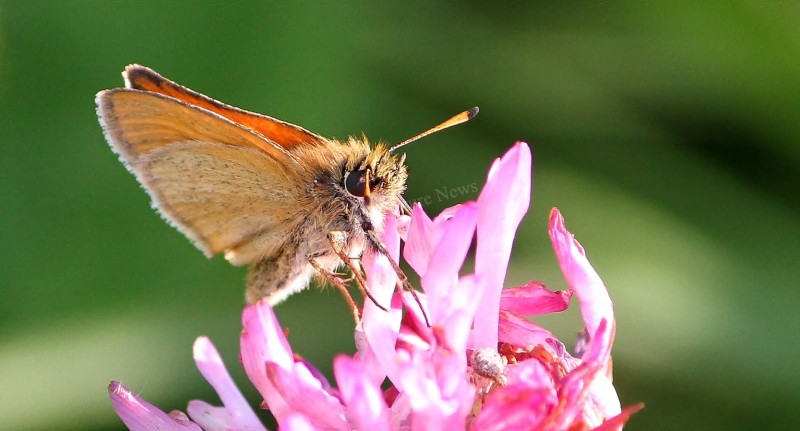
Silver-spotted Skipper Butterfly


This delightful little butterfly is on the wing from late July until early September. They have one brood and the female lays a single egg on Sheep's Fescue (a type of grass), or sometimes on adjacent plants, where they overwinter. In early Spring the larvae hatch and then feed in small silk webs around the food plant. They pupate deep within small tussocks of grass and surrounded by loose silk cocoons. Although the Silver-spotted Skipper is of conservation concern, due to a decline over the last fifty years, its fortunes have improved since the 1980s with the careful management of chalk grassland sites.


Before we set off for the reserve I had made a mental note to look out for another rarity however, when we arrived I was so engrossed in looking for butterflies that I completely forgot but on our way back to the car we passed an information board which mentioned it and decided to double back and make another foray, this time looking not for a butterfly but for a flower.


Consequently I spent another hour or so going uphill...very, very steep, breath taking and back bothering hills ;-) and down dale but with no success having completely lost track of the instructions of the route to follow which were given on the notice board. In the end I admitted defeat and decided to try again another time....Only to get home and find that just the third photo I had taken, on arrival, of a pretty but unknown flower was what I had subsequently spent so long searching for at the end of my visit! Why it didn't dawn on me when I took the photo I really don't know, if it had I would have spent more time taking a better one than this solitary, quick snap :-)


Chiltern Gentian

As we wended our way back through the woodland to the car park this sculpture looked quite magical with the setting sun's rays falling on it through the tree canopy.


A most enjoyable visit rounded off by a couple of Roe Deer running across the track and into the reserve as we started the journey home.

I know this has been rather a lengthy post but as my posts have been few and far between this year I hope I will be forgiven.

Until next time...enjoy the beauty of Nature, wherever you are.

Monday, 22 October 2012

Still Catching Up!


'Real life' rearing its troublesome head has left me with little time or enthusiasm for blogging recently but in an effort to get back to some sort of more regular posting I am aiming to publish a series of catch up posts in an attempt to get through a backlog of photos, some dating back to August, I hope that won't be too boring! This post and probably the next will still be concentrating mainly on invertebrates simply because that is what occupied me on outings the most during our (so called!) Summer but lest anyone should think otherwise, my enthusiasm for birds has not lessened at all and they will feature more strongly in future posts :-) 

My love of butterflies has, in recent years, turned from admiration of their beauty to a deeper interest and desire to actively seek out ones I have never seen before and despite the mainly awful weather we have had in the last few months I have been fortunate to see several this year for the first time. Two of them were shown in earlier posts, the most notable of course was the fantastic Purple Emperor, an amazing and probable once in a lifetime encounter. The Purple Hairstreak was also a first. Another butterfly I very much wanted to find was the Dark Green Fritillary but despite visiting several places where it should apparently have been, including a number of attempts at a location very close to home, I was unlucky this year. However, I was more fortunate in my quest to find the Silver-washed Fritillary but although I saw several on the wing only one posed briefly for the camera and unfortunately what had previously been a sunny afternoon suddenly turned dull and spots of rain were falling as I snatched a very quick photo before it flew off to seek shelter among the trees. Maybe next year I will manage to get a better photo of this striking butterfly.


Silver-washed Fritillary Butterfly


Another butterfly I was pleased to find for the first time this year was the White Admiral, this one, like the Silver-washed Fritillary, looking rather worn at the end of its season.

 
White Admiral Butterfly


Despite the weather it seems to have been a good year for skipper butterflies, I have certainly seen a lot of Large and Small Skippers (as seen on the previous post) but also some Essex Skippers distinguished from the Small Skipper by the black tip on the underneath of the antennae as shown here.

 
  Essex Skipper Butterfly

' "Just living is not enough,”
said the butterfly,
“one must have sunshine,
freedom and a little flower." '
(Hans Christian Anderson)


When passing Ragwort plants I always look out for Cinnabar Moth caterpillars but this year they didn't seem anywhere near as plentiful as usual. Ragwort is poisonous to livestock particularly horses and there has been a concerted effort in the UK to control this native plant resulting in a dramatic reduction in the number of Cinnabars. The caterpillars are not affected by the toxins in the plant and indeed store the poison in their bodies which still remains when they become moths. If predators are not deterred by their bold colouring they will very quickly be repelled by the obnoxious taste!


Cinnabar Moth Caterpillar


I used to think that we in the UK have Grasshoppers while our American friends have Crickets before realising that we have them both here and that the latter can be identified by their much longer antennae. In order to show them more closely I have 'cropped' the antennae on both the photos of crickets below.


Dark Bush-Cricket


There was a little sunshine on the day I saw the next one!


 Roesel's Bush-Cricket

'Twas sweet to see the tiny things,
So bright of garb and so small of size,
But howsoever that might be
Each seemed of perfect symmetry.'
(Thomas Jeffrey Llewelyn Prichard)


 Back to butterflies and all of these I have seen many times before.


Gatekeeper Butterfly


Meadow brown Butterfly


Green-veined White Butterfly


The final butterfly for this post and one of our loveliest I think. 


Peacock Butterfly

'Her slender form, ethereal light,
Her velvet-textured wings unfold:
With all the rainbow's colours bright,
And dropt with spots of burnished gold.'
(William Roscoe)


I always find it difficult to get a photo of a Brown Hawker as they are usually encountered busily patrolling their territory but I did manage to photograph one which was settled and sunning itself on a tree trunk. Not the best of places to show its wings but beggars can't be choosers.


Brown Hawker Dragonfly


 This pretty little damselfly is always a pleasure to find.


Emerald Damselfly


Finally, I will finish as I started (and thank you very much for making it to the end!) with this female Ruddy Darter...I don't think it's a Common Darter? which posed nicely for the camera, it is just a pity that the sun wouldn't pose nicely for so many of these photos...Oh, the joys of living in the UK!


Ruddy Darter Dragonfly (female)

Before I finish, just a quick word to say I have very reluctantly decided to watermark my photographs, not because I think they are worth stealing, I know there are far, far better photos out there than mine and I also realise that once anything is placed on the Internet we, to some extent, surrender ownership but I do think it is worth trying to protect our work and the considerable time and trouble we take to produce it. There are some very unscrupulous people out there and one blogland friend of mine had her entire blog stolen a couple of years ago and passed off by the thief as their own! I recently noticed some slightly odd activity in my blog stats which might be perfectly innocent but I have decided to be safe rather than sorry. I have placed the mark across the middle of the photos, as it would be very easy for someone with ill intent to crop it from the edge but I have tried to make it as unobtrusive as possible.

Again, thank you so much for sticking with me to the end of this rather lengthy post. Until the next time...enjoy the beauty of Nature, wherever you are.